TL;DR
Key takeaways
- The best Retool alternative depends on whether you prioritize lower costs, self-hosting, code ownership, enterprise governance, or full-stack development.
- Appsmith and ToolJet are strong open-source choices for teams that want Retool-style visual builders with more deployment control.
- Budibase suits teams that want a low-code builder with a built-in DB, while Windmill is better for code-first workflows and scripting.
- Superblocks targets teams with stronger enterprise governance needs, while Modelence and Refine offer more control over application code.
- Switching from Retool may require rebuilding or porting the application layer because Retool apps cannot be exported as standalone application code.
Ask AI about this post:
The best Retool alternative depends on what you want to change.
Appsmith is a strong open-source option, ToolJet offers flexible internal-tool development, Budibase combines low-code building with a built-in database (DB), and Modelence is better suited to teams that want to build and own a full-stack application.
This guide compares nine Retool alternatives across cost, deployment, code ownership, self-hosting, and development approach so you can narrow the list based on your team’s priorities rather than features alone.
Why Teams and App Builders Look for Retool Alternatives
Retool is a capable platform for building internal tools quickly, but its trade-offs can become more noticeable as teams grow and applications become more complex.
Common reasons teams look for alternatives include:
- Pricing: Costs can increase as more builders, internal users, or external users need access.
- Customization and lock-in: Teams that want more control over the application layer may prefer open-source or code-first options.
- Feature limits and learning curve: Retool speeds up standard internal-tool development, but highly customized workflows or interfaces can require more effort.
- Security and self-hosting: Retool supports enterprise security, including System and Organization Controls 2 Type II (SOC 2 Type II) controls and self-hosting, but some advanced capabilities are tied to higher-tier plans.
Retool can still be a strong fit for teams with the budget and engineering resources to support it. The question is whether its pricing, flexibility, and deployment model still match the team’s needs as usage grows.
How We Evaluated These Retool Alternatives
We evaluated these Retool alternatives against the trade-offs that matter most as teams scale.
That includes the true 12-month cost for a 10-person or 50-person team, including per-seat, usage-based, and overage charges where applicable. We also considered code ownership and portability, plus whether each platform supports self-hosting or specific data-residency needs.
We also looked at how each platform uses AI assistance and how far it can stretch beyond its default component library when teams need more complex logic or user interface (UI).
No single Retool competitor wins in every dimension.
The best Retool alternative depends on team size, technical depth, compliance requirements, and whether you need a widget builder or a more complete application platform.
9 Retool Alternatives at a Glance
These Retool alternatives take different approaches to internal app development, from open-source visual builders to AI-generated full-stack applications.
Use the tables below for a quick comparison before the individual reviews.
Approach and Capabilities
| Platform | Approach | Built-in DB | Self-Hosting | Open Source | Code Export / Ownership |
|---|---|---|---|---|---|
| Modelence | AI full-stack app builder | Yes | Yes, exported apps can deploy anywhere | Open-source framework | Full source code |
| Appsmith | Low-code visual builder | No native app DB | Yes | Yes | App JavaScript Object Notation (JSON)/Git; requires Appsmith runtime |
| ToolJet | Low-code visual builder + AI | Yes | Yes | Yes | App JSON export; requires ToolJet |
| Budibase | Low-code/no-code platform | Yes | Yes | Yes, core platform | Workspace export; not standalone application code |
| Windmill | Code-first workflows and apps | Data Tables built-in | Yes | Yes | Full-code apps use React/Svelte source but rely on Windmill backend runnables |
| Superblocks | AI internal app platform | No native DB | Hybrid / Cloud-Prem; Cloud-Prem is currently beta | No; on-prem agent is open source | React code export/download available |
| DronaHQ | Low-code visual builder | Yes | Yes | No | App JSON export; platform-dependent |
| Zite | AI no-code platform | Yes | No | No | Zite app export only; no standalone source-code export |
| Refine | AI-generated React apps | No | Yes, exported apps can host anywhere | Open-source framework | Full React/TypeScript source export on Pro |
Pricing Comparison
| Platform | Pricing Model | Free Tier | Builder Cost | End User Cost |
|---|---|---|---|---|
| Modelence | Subscription + usage | Yes | Starter: $20/mo | Workspace-based, no per-seat fees |
| Appsmith | Per user | Yes | Business: $15/user/mo | Same $15/user/mo model; no separate builder/end-user classes |
| ToolJet | Per builder | Yes | Pro: $79/builder/mo | Included for up to 50 end users on Pro |
| Budibase | Base plan + user add-ons | Free self-hosted open-source software (OSS) | Pro: $19/mo annually | $5/user/mo annually |
| Windmill | Seats + compute | Free self-hosted OSS | Enterprise: from $120/mo ($20/developer/mo + compute) | $10/operator/mo |
| Superblocks | Per AI Builder + Governed Agent Unit (GAU) usage | 14-day trial | Teams: $125/AI Builder/mo or $100/AI Builder/mo billed annually | Unlimited end users |
| DronaHQ | Usage-based | Free trial | Starter: $140/mo or $100/mo billed annually | Unlimited users; additional usage $0.002/task |
| Zite | Flat subscription + credits | Yes | Pro: $19/mo or $15/mo billed annually | Unlimited users |
| Refine | AI subscription | No; Starter is $0.99/mo | Pro: $20/mo | No runtime per-seat fee for exported/self-hosted apps |
The pricing details above were verified in August 2026.
9 Retool Alternatives for Teams That Want More Control
1. Modelence
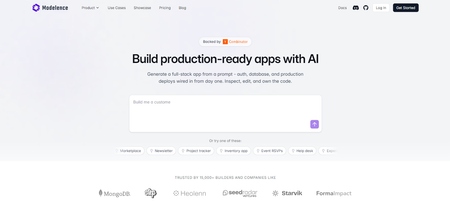
Modelence is an AI app builder that combines frontend, backend, DB, authentication, monitoring, and deployment in one platform.
Teams retain their source code and can export to GitHub or deploy elsewhere.
Key Features
- Full-stack app generation from prompts
- Built-in DB, authentication, monitoring, and deployment
- Editable source code with GitHub export
- Open-source framework with deploy-anywhere portability
Why it’s a good Retool alternative: Modelence fits teams that want to build a complete application rather than mainly assemble an internal-tool UI. It offers more control over the underlying code and architecture.
User Sentiment: Public review volume is still limited. A Product Hunt reviewer praised the integrated full-stack workflow while noting that editing and GitHub integration could improve.
2. Appsmith
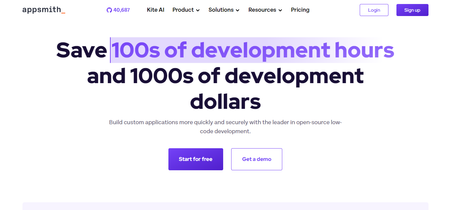
Appsmith is an open-source low-code platform for building internal tools, dashboards, and admin panels.
It combines a drag-and-drop interface with JavaScript, DB/Application Programming Interface (API) connections, and self-hosting.
Key Features
- Open-source with cloud or self-hosted deployment
- Pre-built widgets and visual builder
- JavaScript for custom business logic
- DB, Representational State Transfer Application Programming Interface (REST API), and GraphQL integrations
- Git-based version control
Why it’s a good Retool alternative: Appsmith offers a similar visual approach while giving teams an open-source, self-hostable option. It suits teams that want Retool-style internal tools with more deployment control.
User Sentiment: A Reddit thread on Appsmith vs ToolJet viewed Appsmith’s open-source model as a key advantage. G2 reviewers also mention its fast setup, integrations, and flexibility with JavaScript, while some note UI customization limits, performance issues with larger apps, and a learning curve.
3. ToolJet
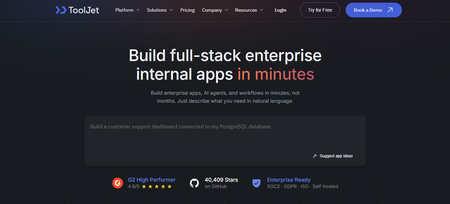
ToolJet is an open-source platform for building internal tools and business apps with a visual editor, custom JavaScript or Python, and 80+ integrations.
It also includes a PostgreSQL-backed DB and supports cloud or self-hosted deployment.
Key Features
- Drag-and-drop visual builder with 80+ integrations
- Built-in PostgreSQL-backed DB
- JavaScript and Python for custom logic
- Self-hosting, GitSync, workflows, and AI app generation
Why it’s a good Retool alternative: Like Appsmith, ToolJet offers an open-source, self-hostable visual builder. ToolJet stands out with its built-in DB, workflow automation, and AI agents.
User Sentiment: In a Reddit discussion, one self-hosted user running a production inventory dashboard for 400+ users said performance had improved significantly, while another noted ToolJet’s development UI felt nicer but somewhat less stable.
4. Budibase
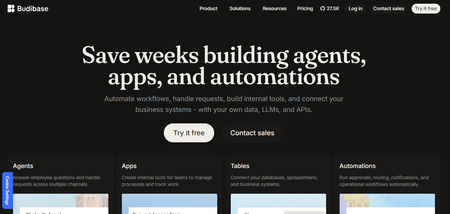
Budibase is an open-source low-code platform for building internal tools and automating workflows. It includes its own DB but can also connect to external DBs and APIs.
Key Features
- Built-in Budibase DB
- Drag-and-drop app builder
- Workflow automations
- External DB and API connections
- Cloud or self-hosted deployment
Why it’s a good Retool alternative: Budibase suits teams that want an open-source builder with a DB included, reducing setup for apps that do not already have a data layer. Self-hosting also gives teams more control over deployment.
User Sentiment: G2 reviewers often highlight its ease of use, visual builder, and integrations. Some also point to pricing or limits in more complex use cases as drawbacks.
5. Windmill
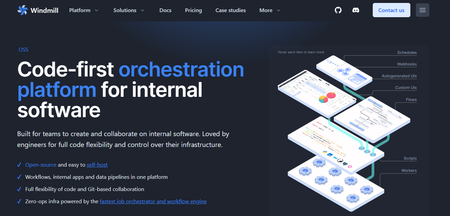
Windmill is an open-source developer platform for turning scripts into workflows, APIs, and internal apps.
It supports languages such as Python, TypeScript, Go, Bash, and Structured Query Language (SQL), with cloud or self-hosted deployment.
Key Features
- Script-based workflows and internal tools
- Python, TypeScript, Go, Bash, SQL, and other languages
- Low-code and full-code app builders
- Self-hosting with Docker or Kubernetes
- Git sync, Role-Based Access Control (RBAC), Single Sign-On (SSO), and audit logs
Why it’s a good Retool alternative: Windmill fits code-first teams that would rather build around scripts and workflows than rely mainly on drag-and-drop components. It also gives teams more control through open-source and self-hosted deployment.
User Sentiment: One Hacker News user who migrated to Windmill said they were very happy with the switch, while noting that the platform had been less mature when they first evaluated it.
6. Superblocks
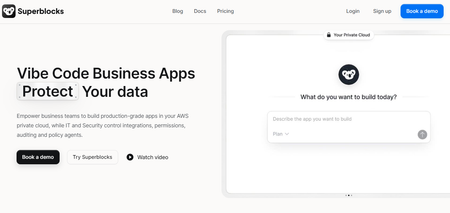
Superblocks is an AI-focused platform for building and governing internal apps on enterprise data.
It combines AI generation with integrations, RBAC, audit logs, Git-based workflows, and flexible deployment options.
Key Features
- AI app generation with Clark
- React and TypeScript code editing
- RBAC, SSO, audit logs, and centralized integrations
- Git-based source control and continuous integration/continuous delivery (CI/CD)
- Cloud, Hybrid, and Cloud-Prem deployment
Why it’s a good Retool alternative: Superblocks is a strong fit for teams that want more enterprise governance, code control, and flexible deployment than a standard internal-tool builder.
User Sentiment: Ease of setup, fast app development, and support for complex data integrations are recurring positives in Product Hunt reviews. Some reviewers also wanted additional analytics and role-management features.
7. DronaHQ
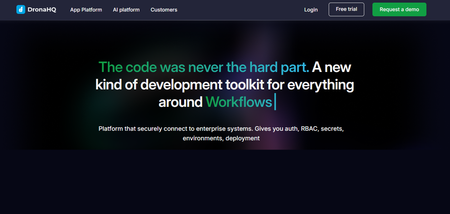
DronaHQ is a low-code platform for building internal tools, admin panels, dashboards, and operational apps. It supports visual development, data integrations, automation, and cloud or self-hosted deployment.
Key Features
- Drag-and-drop app builder
- DB and API integrations
- Workflow automation
- User roles and audit logs
- Cloud and self-hosted deployment
Why it’s a good Retool alternative: DronaHQ fits teams that want flexible pricing and a Retool-like visual builder with self-hosting options.
User Sentiment: Ease of building internal tools and broad feature coverage come up in G2 reviews, while some users mention a learning curve because of the platform’s breadth.
8. Zite
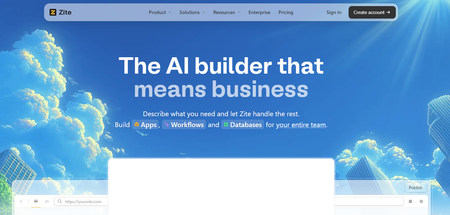
Zite is an AI-powered no-code builder for creating internal tools, dashboards, portals, and business apps from plain-language prompts. It includes built-in data storage and workflows.
Key Features
- AI app generation from prompts
- Built-in DB and workflows
- Visual editing with no coding required
- Access controls for internal or external apps
Why it’s a good Retool alternative: Zite suits non-technical teams that want to build business apps without managing code or infrastructure.
User Sentiment: In a Reddit discussion, one user found Zite easy for non-developers to pick up and fast for turning an idea into a working prototype.
9. Refine
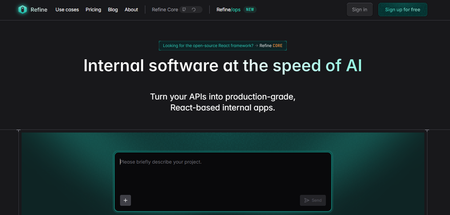
Refine is an AI-powered builder for React-based internal apps, admin panels, and dashboards. Its Pro plan lets teams export the generated React/TypeScript source code and host it elsewhere.
Key Features
- AI-generated React applications
- REST API and Supabase connections
- Interactive code editor
- Full source-code export on Pro
- Self-hosting and flexible deployment
Why it’s a good Retool alternative: Refine suits teams that want AI-assisted development without giving up ownership of the application code.
User Sentiment: Documentation and flexibility are common positives in Product Hunt reviews, particularly among developers building React-based internal tools.
Considerations for Choosing the Right Retool Alternative
Start with the reason you are leaving Retool rather than comparing feature lists.
- Per-user cost: Consider Appsmith for an open-source option or ToolJet if avoiding end-user fees is important.
- Built-in DB: Budibase combines its visual builder with its own DB, reducing setup for simpler internal apps.
- Code-first workflows: Windmill is built around scripts, workflows, and apps rather than a primarily drag-and-drop approach.
- Enterprise governance: Superblocks supports code export and a lightweight on-premise agent for teams with stricter data residency requirements.
- Managed low-code: UI Bakery or DronaHQ are worth comparing if you want a Retool-like experience without managing the platform yourself.
- Code ownership: Refine provides React code, while Modelence generates full-stack applications whose code can be exported and deployed elsewhere.
Also consider vendor lock-in before switching.
Retool apps can be exported in Retool-specific formats, but not as standalone React or HyperText Markup Language (HTML) applications, so moving to a different platform generally means rebuilding or porting the application layer.
Choosing Between a Widget Builder or App Builder
Widget builders such as Retool, Appsmith, ToolJet, and Budibase are well suited to quickly building admin panels and internal tools around existing data.
Full-stack platforms such as Modelence go further by combining the frontend, backend, DB, authentication, and deployment, making them a better fit when an internal tool may grow into a more complete application.
Final Thoughts
The best Retool alternative depends on whether you need a faster internal-tool builder or more control over a complete application.
Appsmith, ToolJet, Budibase, and similar platforms are strong fits for teams that mainly need dashboards and admin tools, while code-first and full-stack options give developers more ownership as requirements grow.
Modelence is worth considering if you are starting from scratch or expect an internal tool to grow into a larger application. You can try Modelence for free to see whether its full-stack approach fits your workflow.
Frequently asked questions (FAQs)
What is the best free alternative to Retool?
Appsmith is a strong free option because its open-source Community Edition can be self-hosted at no cost.
Can I self-host a Retool alternative?
Yes, Appsmith, ToolJet, Budibase, and Windmill all support self-hosting.
Is Retool open source?
No, Retool is proprietary software, though self-hosting is available on higher-tier plans.
What happens to my apps if I leave Retool?
Retool apps are not exported as standalone application code, so switching platforms generally means rebuilding or porting the app layer.
Which Retool alternative is best for non-developers?
Zite is a strong no-code option, while Budibase suits teams that prefer a visual low-code builder.
Does Retool charge for end users?
Yes, Retool charges for internal users separately from builders on paid plans.
Can I export my Retool apps as code?
Not as standalone React, HTML, Cascading Style Sheets (CSS), and JavaScript code.
Is there a Retool alternative that includes a DB and hosting?
Yes, Budibase includes built-in data storage and supports both managed hosting and self-hosting.
Related articles