TL;DR
Key takeaways
- In February 2026, Heroku moved to a sustaining engineering model focused on stability and security rather than new features, and stopped offering Enterprise contracts to new customers.
- Heroku dynos start at $5 a month for Eco and $25 for Standard-1X, and Heroku Postgres with high availability starts at $200 a month on Premium-0.
- Render, Fly.io and DigitalOcean App Platform publish Heroku migration guides that map each Procfile process to a service on their platform.
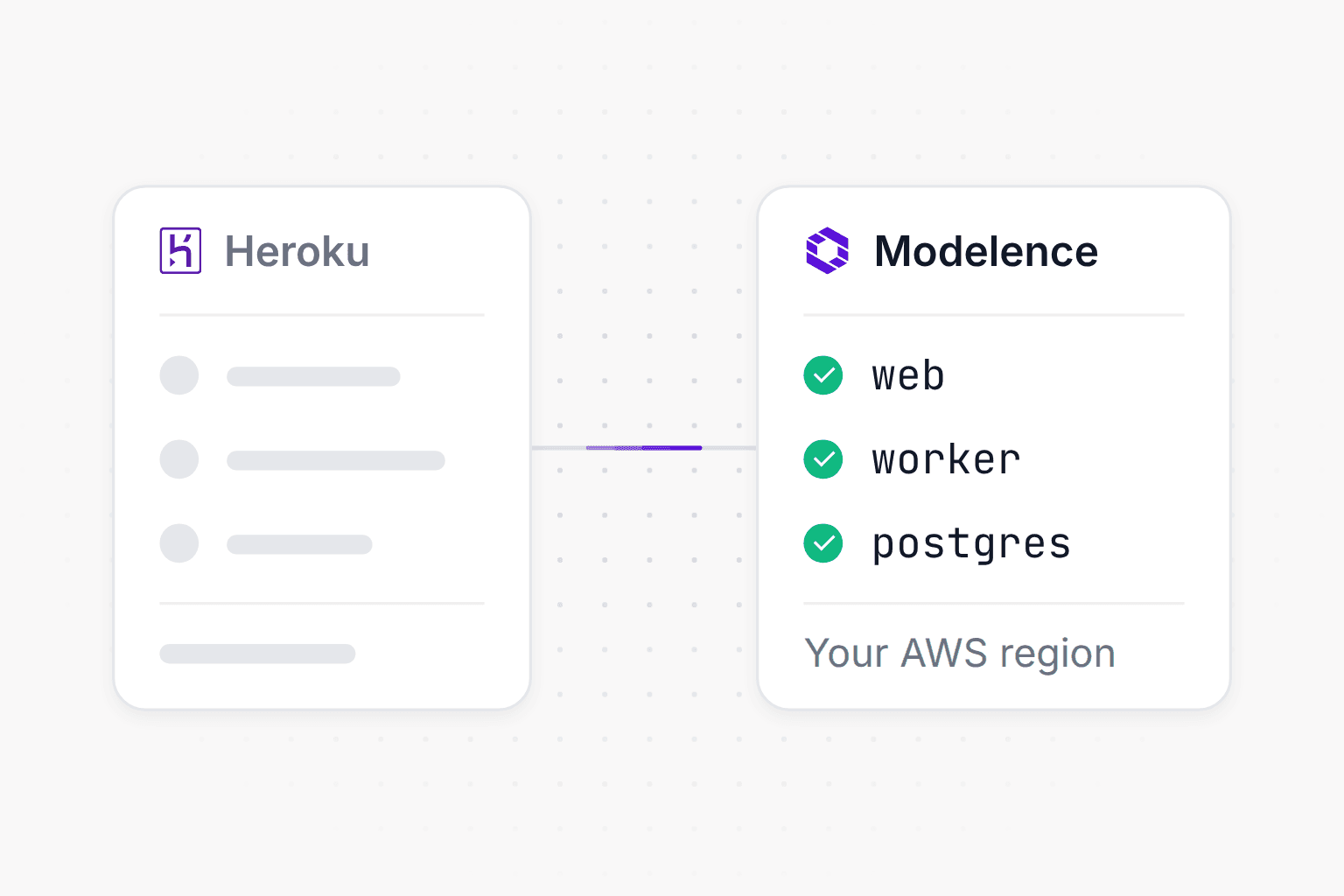
- Heroku runs on AWS, and teams that need their app in a specific AWS region or in their own AWS account can use Modelence, Porter, Northflank or ECS Express Mode.
- Modelence deploys services and their Postgres, MongoDB and Redis databases to AWS in 17 regions across two availability zones, and on Pro and above operates them 24/7.
Ask AI about this post:
The best Heroku alternatives in 2026 are Render and Railway for a similar push-to-deploy experience, Modelence when you want your app and its databases on AWS in a region you choose with the operating handled for you, and Fly.io for running close to users around the world. Teams that would rather run things in their own cloud account have Porter, Northflank and AWS ECS Express Mode, and Dokku recreates the Heroku workflow on a server you own. This guide compares ten Heroku alternatives on pricing, databases and regions, along with what each one leaves to you, using prices checked on November 25, 2026.
Why teams look for Heroku alternatives
Heroku popularized git push deploys, buildpacks and the Procfile as a way to ship web apps, and it still runs a lot of production software. The reasons teams look elsewhere in 2026 are mostly about where the platform is heading and what it costs to run an app properly on it:
- Heroku's direction. On February 6, 2026, Heroku announced that it is moving to a sustaining engineering model focused on stability, security, reliability and support rather than new features, and that Enterprise Account contracts are no longer offered to new customers. Existing contracts are honored, and card-paying customers can keep signing up with no change to pricing.
- Cost of a production setup. Dynos are priced per process, so a web dyno and a worker on Standard-1X cost $50 a month together. Heroku Postgres Standard-0 adds $50 and has no high availability, which starts with Premium-0 at $200 a month.
- Regions. Apps on the Common Runtime run in one of two regions, the US or Europe. The other ten locations, such as Montreal, Sydney and Tokyo, are available only in Private Spaces, which need a Heroku Team or Enterprise account.
- Platform limits. The router ends any request that takes longer than 30 seconds, and the timeout can't be changed. Long AI calls, large exports and slow webhooks have to move to a worker even when a longer request would be simpler.
- Upgrade work you have to do anyway. The Heroku-22 stack reaches end of life on April 30, 2027, and Heroku's newer Fir generation is available only in Private Spaces today. When an app needs a stack upgrade either way, many teams use that moment to compare platforms.
Reliability is part of the picture too. On June 10, 2025, an unintended system update caused up to 24 hours of downtime for many Heroku customers, and Heroku published a corrective action plan afterwards.
The best Heroku alternatives at a glance
| Platform | Starting price | Managed databases | Regions |
|---|---|---|---|
| Modelence | Free; Starter $20/mo | Postgres, MongoDB, Redis | 17 AWS regions |
| Render | Instances from $7/mo | Postgres, Key Value | 5 |
| Railway | Free; Hobby $5/mo | Postgres, MySQL, Redis, MongoDB | 4 |
| Fly.io | Free plan; Machines from $2.19/mo | Postgres from $4/mo; Redis via Upstash | Six continents |
| DigitalOcean App Platform | Containers from $5/mo | Postgres, MySQL, MongoDB, Valkey | 12 |
| Northflank | Free sandbox; from $2.70/mo | Postgres, MySQL, MongoDB, Redis | 17, or your own cloud |
| Porter | $13 per vCPU/mo plus your cloud bill | RDS, Aurora, ElastiCache in your AWS account | Your cloud account |
| AWS ECS Express Mode | About $60/mo with RDS | RDS, ElastiCache | Nearly all AWS regions |
| Google Cloud Run | Free tier, then per use | Cloud SQL, Memorystore | Google Cloud regions |
| Dokku | Free and open source | Plugins on your server | Your servers |
The 10 best Heroku alternatives in 2026
1. Modelence
Modelence is a Heroku alternative that runs on AWS across two availability zones, with managed databases and zero-downtime deploys. An app is described in one modelence.config.json file, which can hold several services, such as a web process, a worker and an API, along with their databases and secrets. That maps closely to a Heroku Procfile with its add-ons. Your coding agent can write the file by reading modelence.com/skill.md, and the first deploy creates everything in the AWS region you choose and passes the connection strings to the app.
Best for: teams that like Heroku's simplicity, want their app on AWS in a specific region, and would rather not be the ones watching it around the clock.
How it runs your app: apps in any language are built into a Docker image, from your own Dockerfile or from build and start commands. Containers run on AWS Fargate across two availability zones and are health-checked every 30 seconds. A new version starts next to the running one and only takes traffic once it passes its health checks, and if it keeps crashing the deploy is rolled back while the previous version keeps serving. Every app gets a sandbox and a production environment. Read more on the deployment and infrastructure pages.
Operating: on Pro and above, production autopilot operates the app 24/7. Crashed processes are restarted, traffic is rerouted and capacity is added under load, and you get a report of what happened. Problems that need a code change, such as a memory leak or a slow query, are traced to where they start in your code. See monitoring.
Databases: managed Postgres, MongoDB and Redis, created in the same region as the app. Production databases fail over to a healthy machine automatically and are snapshotted at least every six hours, with encrypted snapshots kept on a rolling schedule for up to 12 months. See managed databases.
Regions: 17 AWS regions across the Americas, Europe and Asia Pacific, including Montreal, Frankfurt and Sydney. Data is encrypted at rest and in transit, production services run to a 99.9% uptime target with a public status page, and Modelence signs BAAs on the Enterprise plan. The security page covers the rest of a typical customer review.
Pricing: free for side projects. Starter is $20 a month, Pro is $100 and Scale is $500, and each paid plan includes its price in cloud usage, so the bill stays at the plan price unless your apps run more than it covers. The smallest instance, 0.25 vCPU with 0.5 GB of memory, is about $9 a month of that usage. See pricing.
Portability: Modelence runs on standard AWS primitives, so if you later build your own DevOps team, you can recreate the setup in your own AWS account.
2. Render
Render is the platform most often compared with Heroku. It runs web services, background workers and cron jobs from a Git repo or a Dockerfile, next to managed Postgres and a Redis-compatible Key Value store.
Best for: teams that want a Heroku-like platform with fixed instance prices and point-in-time recovery for Postgres on every paid plan.
Pricing: the Hobby workspace is free plus compute, Pro is $25 a month plus compute and Scale is $499. Paid web services start at $7 a month for 0.5 CPU and 512 MB of RAM, the same memory as a Heroku Basic dyno. Free web services spin down after 15 minutes without traffic.
Databases: Postgres starts at $6 a month for 256 MB of RAM, with storage at $0.30 per GB and point-in-time recovery of 3 days on Hobby and 7 days on Pro and up. Paid Key Value plans start at $10 a month. Free Postgres databases expire after 30 days.
Regions: five, with Oregon, Ohio and Virginia in the US plus Frankfurt and Singapore.
Moving from Heroku: Render has a Heroku migration guide and offers credits for teams that move. Render uses its own native runtimes instead of buildpacks, so each Procfile process becomes a separate Render service, and the release command becomes a pre-deploy command.
Tradeoff: bandwidth beyond the plan allowance (5 GB on Hobby, 25 GB on Pro) costs $0.15 per GB, and autoscaling is available only on Pro and above.
3. Railway
Railway deploys services and databases from a repo with very little setup, and bills CPU and memory by the second as your services use them.
Best for: small teams and side projects whose load comes and goes, since idle services cost little.
Pricing: a Free plan includes $1 of usage a month, Hobby is $5 a month and Pro is $20, each including that much usage. Compute is about $20 per vCPU and $10 per GB of memory a month, and egress is $0.05 per GB.
Databases: Postgres, MySQL, Redis and MongoDB, with high-availability versions of each and backups and point-in-time recovery for Postgres and MySQL. Cron jobs start a service on a schedule, at least five minutes apart, and expect it to exit.
Regions: four, California, Virginia, Amsterdam and Singapore, all on hardware Railway owns and operates.
Moving from Heroku: Railway's builder detects a Procfile, though its Heroku guide notes that only a single process is supported that way, so a web and worker pair becomes two services.
Tradeoff: Railway offers an uptime SLA only on Enterprise, and in October 2026 it reported a security incident in which an attacker decrypted a subset of environment variables in up to about 1.85% of workspaces. Our Railway alternatives guide covers the platform in more depth, and Railway vs Render compares the two side by side.
4. Fly.io
Fly.io runs your app as lightweight virtual machines, called Machines, and makes it easy to place them near your users.
Best for: latency-sensitive apps with a global user base, and teams comfortable working closer to the infrastructure.
Pricing: new accounts start on a Free plan, which covers $5 of usage a month once a card is added, for up to three Machines, and Pay As You Go has no monthly fee. A shared-cpu-1x Machine with 256 MB costs $2.19 a month in Ashburn, extra memory is $6 per GB a month, and outbound data is $0.02 per GB in North America and Europe.
Databases: Fly Managed Postgres starts at $4 a month on the Developer plan, which pauses after 15 minutes without a client, and the Basic plan with 1 GB is $38 a month. Every plan includes high availability and automated backups, and Basic and up add point-in-time restore. Redis comes through Upstash and is billed at Upstash's prices.
Regions: regions on six continents, including Toronto, Sydney and Johannesburg.
Moving from Heroku: Fly's Heroku migration guide uses fly launch to generate a Dockerfile, and Procfile processes map directly to Fly processes.
Tradeoff: you work with Machines, volumes and networking more directly than on Heroku, which gives you more control and asks for more infrastructure knowledge.
5. DigitalOcean App Platform
App Platform is DigitalOcean's managed PaaS. It builds from a repo with Cloud Native Buildpacks or a Dockerfile and runs web services, workers and jobs next to DigitalOcean's managed databases.
Best for: teams already on DigitalOcean, or those who want simple flat pricing.
Pricing: up to three static-site apps are free. The smallest container is $5 a month with 512 MiB of memory and 50 GiB of transfer, and extra transfer is $0.02 per GiB.
Databases: a development Postgres database costs $7 a month but is not backed up by default and is deleted with the app. Managed Postgres, MySQL, MongoDB and Valkey start at about $15 a month.
Regions: 12 for apps, including New York, San Francisco, Toronto, London, Frankfurt, Amsterdam, Bangalore, Singapore and Sydney.
Moving from Heroku: DigitalOcean's Heroku migration guide maps the Procfile into an app spec, with web as a web service, worker as a worker and release as a pre-deploy job, Heroku Postgres to Managed PostgreSQL and Heroku Key-Value Store to Valkey.
Tradeoff: the $5 and $10 containers run as one fixed instance, and autoscaling on CPU needs dedicated-CPU instances, though autoscaling on request rate also works on shared plans.
6. Northflank
Northflank is a container platform that runs services, jobs and databases on its own managed cloud or inside your own cloud account.
Best for: teams that want PaaS ergonomics now and the option to run in their own AWS, Google Cloud or Azure account later.
Pricing: a free Sandbox covers two services, two jobs and one database without sleeping. Usage is billed by the second, with plans from about $2.70 a month for 0.1 vCPU and 256 MB and $12 for 0.5 vCPU and 1 GB, and egress is $0.06 per GB.
Databases: managed addons for Postgres, MySQL, MongoDB, Redis and a few other engines. Scheduled work runs as jobs with a crontab.
Regions: 17 on Northflank's managed cloud, or any region of a cloud you bring, with AWS, Google Cloud, Azure, Oracle and CoreWeave listed for bring-your-own-cloud.
Moving from Heroku: Northflank builds with Heroku buildpacks as well as Dockerfiles and has a Heroku migration page.
Tradeoff: there are more concepts to learn than on Heroku, such as addons, secret groups and BYOC clusters, which pays off at scale and slows down a first deploy.
7. Porter
Porter is a PaaS that runs inside your own AWS, Google Cloud or Azure account. It sets up a Kubernetes cluster there (EKS on AWS) and gives you a Heroku-style interface for deploying apps onto it.
Best for: teams that need everything in their own cloud account, often because of customer contracts, and have the budget for a platform fee on top of the cloud bill.
Pricing: the Standard plan is $13 per vCPU and $6 per GB of memory a month, plus whatever your cloud provider charges for the resources underneath. There is no free tier.
Databases: on AWS, Porter can create Postgres on RDS Multi-AZ or Aurora and Redis on ElastiCache in your account, or run them inside the cluster. Managed datastores on Google Cloud and Azure are on its roadmap.
Regions: whichever regions your cloud account uses.
Moving from Heroku: Porter supports Heroku's buildpacks, and its porter.yaml declares processes much like a Procfile. See its Heroku migration docs.
Tradeoff: you pay two bills, and a Kubernetes cluster runs in your account even for a small app, so it suits teams that have outgrown a shared platform more than early projects.
8. AWS with ECS Express Mode
If the reason you are leaving Heroku is that you want to run AWS yourself, the closest native service is ECS Express Mode. You give it a container image, and it creates a Fargate service in your account with a load balancer, HTTPS, autoscaling and monitoring. AWS App Runner, the older option, stopped accepting new customers on April 30, 2026, and AWS recommends Express Mode in its place. Elastic Beanstalk is still available and reads a Procfile on most of its Linux platforms.
Best for: teams with AWS experience that want full control in their own account.
Pricing: Express Mode itself is free, and you pay for the resources it creates. A small app with one Fargate task (0.5 vCPU, 1 GB), a load balancer and the smallest RDS Postgres instance comes to about $60 a month in us-east-1, before logs and data transfer. Express Mode's default task size is 1 vCPU with 2 GB, which roughly doubles the compute line.
Databases: Postgres and MySQL on RDS, Redis-compatible Valkey on ElastiCache, and scheduled jobs through EventBridge Scheduler running ECS tasks.
Regions: nearly every AWS region.
Tradeoff: you own the operating, from networking and IAM to alarms and on-call, and Express Mode needs a container image, so you set up the build pipeline that Heroku's buildpacks used to handle.
9. Google Cloud Run
Cloud Run runs containers on Google Cloud and scales them with requests, down to zero when idle. gcloud run deploy --source builds your code with Google Cloud's buildpacks, so a Heroku-style repo without a Dockerfile can deploy directly.
Best for: stateless APIs with uneven traffic on Google Cloud.
Pricing: with request-based billing, the first 180,000 vCPU-seconds, 360,000 GiB-seconds and 2 million requests each month are free, and usage after that is rounded up to the nearest 100 milliseconds.
Databases: Postgres comes from Cloud SQL and Redis from Memorystore, each set up and billed separately. Scheduled work runs as Cloud Run jobs triggered by Cloud Scheduler.
Regions: Google Cloud regions across the world.
Tradeoff: you put the pieces together yourself in Google Cloud, including networking and IAM, so a web, worker and database setup takes more work than on Heroku.
10. Dokku
Dokku is an open-source, MIT-licensed PaaS that describes itself as a single-host version of Heroku. You git push to your own server, and it builds the app with Heroku buildpacks or a Dockerfile and runs the processes in your Procfile.
Best for: developers who want the Heroku workflow on a VPS or their own hardware, at server cost.
Pricing: free and open source. Dokku Pro, which adds a web UI and an API, is a one-time $849 lifetime license for one production server and two pre-production servers.
Databases: official plugins for Postgres, Redis, MySQL, MongoDB and more, with backups to Amazon S3 or S3-compatible storage on a schedule.
Regions: wherever your servers are. Dokku runs on Ubuntu or Debian with at least 1 GB of RAM, and a k3s scheduler spreads apps across several servers.
Tradeoff: you are responsible for the servers, including OS updates, database failover and recovering when a machine goes down.
Heroku vs Render vs Railway
Heroku vs Render
Both run web services, workers and Postgres from a repo with fixed prices per instance, and the entry points line up closely: a Heroku Basic dyno and Render's smallest paid instance each cost $7 a month for 512 MB. The differences show up as an app grows. Render includes point-in-time recovery on every paid Postgres plan and offers five regions to everyone, while Heroku Postgres adds high availability from Premium-0 at $200 a month and keeps regions beyond the US and Europe inside Private Spaces.
Heroku vs Railway
Railway bills CPU and memory by the second, so a quiet app can cost a few dollars a month, while Heroku charges a fixed price per dyno whether it is busy or not. Railway runs on its own hardware in four regions, and Heroku runs on AWS in two regions on its Common Runtime. Heroku has the longer track record and publishes no per-GB bandwidth price, with a soft limit of 2 TB per app a month, while Railway charges $0.05 per GB of egress.
Running a Heroku-style app on AWS
Heroku itself runs on AWS, and its newer Fir generation is built on Amazon EKS. When people look for Heroku on AWS, they usually want the app in a specific AWS region or in their own AWS account, because customers or regulators ask for it. There are three ways to get there:
- A managed platform on AWS. Modelence runs your services and their Postgres, MongoDB and Redis databases on AWS in any of 17 regions and operates them for you, so you choose the region without managing the account.
- A platform in your own account. Porter and Northflank's bring-your-own-cloud option deploy into an AWS account you own, with the platform handling deploys and you handling the account.
- AWS directly. ECS Express Mode or Elastic Beanstalk, with RDS and ElastiCache for data, gives you full control and full responsibility for operating it.
How to choose a Heroku alternative
Start from the reason you are leaving, since each one points to a different platform:
- You want the same experience on an actively developed platform: Render, Railway or DigitalOcean App Platform.
- You need AWS, more regions or data residency: Modelence for 17 AWS regions without running AWS yourself, Porter or Northflank BYOC for your own account, or ECS Express Mode if you have the team to operate AWS directly.
- Your users are spread around the world: Fly.io for placing Machines close to them.
- You want the lowest cost and have ops experience: Dokku on your own servers, or Cloud Run if your traffic is bursty.
- You don't want to be on call: pick a platform that operates the app after the deploy, which is what Modelence's production autopilot does on Pro and above.
Before you commit, map your current dynos and add-on plans onto each candidate's instance sizes and database plans, since database high availability and bandwidth are where totals differ most.
How to migrate off Heroku
A Heroku app moves in roughly the same steps wherever it is going:
- List your config vars and add-ons.
heroku config -a your-app --shellprints every config var, andheroku addons -a your-appshows the databases and services attached to the app. Skip the connection strings that add-ons set, such asDATABASE_URLandREDIS_URL, since the new databases come with their own. - Recreate the processes. Each line of the Procfile becomes a service on the new platform:
webserves traffic,workerruns in the background, and thereleasecommand, which usually runs migrations, becomes a pre-deploy step or part of the start command. On Modelence, your coding agent can read the Procfile and write each process into the config file. Our deploy guides for Node.js, Docker and other stacks walk through the setup. - Copy the database. Put the app in maintenance mode with
heroku maintenance:on -a your-app, capture a fresh backup withheroku pg:backups:capture -a your-app, download it from the URL thatheroku pg:backups:url -a your-appreturns, and restore it withpg_restore --no-acl --no-owner -d "$NEW_DATABASE_URL" latest.dump. A Key-Value Store that only holds a cache can start empty. - Move scheduled jobs. Heroku Scheduler jobs become cron jobs or scheduled jobs on the new platform, and it is a good moment to give them exact schedules instead of the 10-minute, hourly and daily options.
- Switch the domain. Lower the DNS TTL a day ahead, check the new app on its own URL, then point your domain at it and turn maintenance mode off once traffic has moved.
The app is down only while the backup is captured and restored, and that time grows with the size of the database, so run the restore once against a test database beforehand to know how long the window will be.
Frequently asked questions (FAQs)
What is the best alternative to Heroku?
Render is the closest like-for-like replacement, with web services, workers, cron jobs and managed Postgres at fixed instance prices. If you want your app and its databases on AWS in a region you choose, with the operating handled for you, Modelence is the better fit. Railway suits apps with uneven load, and Fly.io suits apps that need to run close to users around the world.
Is Heroku shutting down?
No. In February 2026 Heroku moved to a sustaining engineering model focused on stability, security, reliability and support instead of new features. Existing apps keep running, existing Enterprise contracts are honored, and card-paying customers can still sign up with no change to pricing, while new Enterprise contracts are no longer offered.
Does Heroku run on AWS?
Yes. Heroku's infrastructure is hosted in Amazon's data centers, and its Fir generation is built on Amazon EKS. On the Common Runtime you choose between a US and a Europe region, and Private Spaces add ten more. To run an app in any of 17 AWS regions without managing AWS yourself, you can use Modelence, and to run it in your own AWS account, Porter, Northflank or ECS Express Mode.
Is there a free Heroku alternative?
Heroku has no free tier, and its Eco plan costs $5 a month for a shared pool of dyno hours, with dynos that sleep after 30 minutes without traffic. Modelence and Render both have free plans for side projects, Northflank's Sandbox is free, and Dokku is free and open source on a server you run.
Is Render cheaper than Heroku?
At the entry level they cost about the same, since a Heroku Basic dyno and Render's smallest paid instance are each $7 a month for 512 MB. Render's Postgres starts at $6 a month with point-in-time recovery, while Heroku Postgres starts at $5 for Essential-0 and adds high availability from Premium-0 at $200 a month. Render charges $0.15 per GB of bandwidth beyond the plan allowance, while Heroku publishes no per-GB bandwidth price.
How do I move my Heroku Postgres database?
Put the app in maintenance mode, capture a backup with heroku pg:backups:capture, download it and restore it into the new database with pg_restore. Then point the app at the new connection string and turn maintenance mode off. The app is unavailable only while the backup and restore run.
What replaces Heroku Scheduler?
Most alternatives have scheduled jobs built in. Render, Railway and Northflank take cron expressions, and on Modelence scheduled jobs run inside your app on a timer, so you can set exact schedules instead of Heroku Scheduler's 10-minute, hourly and daily options.
Related articles